I read a fair bit of “quit lit” on my way out of academia. But it was Kristiana Willsey’s sci-fi, dark academia short story, “To Put Your Heart into a White Deer,” that helped me walk out of the ivory tower and not look back.
Set against a backdrop of climate disaster, the protagonist of “Put Your Heart” studies literature in a prestigious PhD program. The story imagines a not so distant future where literary analysis is relegated to computer programming: the apotheosis of AI in the humanities.
As the world around the protagonist collapses (the air quality is so bad that everyone wears masks and universities are run by corporations) the story depicts a number of really good reasons why any person should ditch the ivory tower.
Universities are built on entrenched class hierarchies, rife with sexual harassment, foster intellectual gatekeeping, and reward advisors who cannibalize their advisees’ ideas. “Put Your Heart” captures these problems alongside the hope that underrepresented folks in academia hold onto. But this hope is coupled with the pain of our failures because we’re also alienated from our families and home communities because of our access to the ivory tower.
Reading “Put Your Heart” with its critical stance toward elite institutions reminded me of the ethos of quit lit. And, in turn, “Put Your Heart” helped me see how quit lit as a genre is deeply about labor and labor consciousness.

Quit lit is a genre written by former academics about their decision to leave the ivory tower.*
Quit lit essays often critique academic institutions for pushing out talented and hard-working teachers and researchers, and they especially critique how academic cultures shame those who walk away for being “failures.”
For context, the majority of people who leave academia don’t simply “quit,” as researcher Laura McKenzie finds. These folks are precariously situated within the academy to begin with; many are “recent PhDs who have worked in short-term, part-time positions for years or even decades,” says McKenzie. “They are pushed out, not rehired, stuck in difficult work environments. In many cases, scholars’ contracts simply end, after which they vanish.” It’s these folks–the contingent laborers from grad students to adjuncts–who are leaving and writing quit lit.**
There are many good examples of quit lit. For a taste, start with Erin Bartram’s viral 2018 essay. And if you’re curious why humanities PhD programs are so terrible and worth quitting, you should check out Anna Williams podcast dissertation which argues that graduate education shares all the terror (and terrible pedagogy) of a gothic novel.
These and other examples of quit lit are confessional as authors attempt to justify their decision to leave as much for themselves as for their audience of other academic escapees. Quit lit essays are deeply painful accounts to read, as McKenzie attests, because the ivory tower casts a shadow over those who leave and instills in them a sense of guilt for not having found success within its walls.
Part of the problem, as many see it, is that institutions fail to reckon with the number of people who leave.
“Those left behind, or, as we usually think of them, those who “succeeded”, don’t often write about what it means to lose friends and colleagues. To do so would be to acknowledge not only the magnitude of the loss but also that it was a loss at all. If we don’t see the loss of all of these scholars as an actual loss to the field, let alone as the loss of so many years of people’s lives, is it any wonder I felt I had no right to grieve? Why should I be sad about what has happened when the field itself won’t be?”
Erin Bartram, “The Sublimated Grief of the Left Behind“
It’s painful to realize that you’ll be forgotten, that no matter how dexterously you can reason out the structural problems of higher ed, the door is still closing behind you.
Thus, many academic escapees take to writing as a way to grieve, and writing becomes a place to put all the conflicting emotions that come with quitting the ivory tower.
There are other places to put one’s heart besides the personal essay. Kristiana Willsey turns to sci-fi to take on some of the same themes that animate quit lit.***
The story’s narrator, Elena, is a class outsider from the Midwest who stumbles wearily through an East Coast, ivy-league English PhD program. Along the way she finds herself at the intellectual (and financial) mercy of those who broker knowledge.
Much of this gatekeeping is enforced by her peers. For instance, she is made fun of for not fluently using her “lenses”–devices that allows the user to access the internet and compose text mentally, something her more privileged peers have had since childhood. Elena muses: “As a latecomer to higher education and its associated technological perks, it was difficult to avoid being read as a child, an idiot, or both.”
Her technological isolation is compounded by the entitlements of her “legacy” peers who “mostly lived in trim red-brick rowhouses at the heart of campus, where they played at being poor by sharing a building named for someone else’s parents.” While her peers remain oblivious to her class position, she is acutely aware of theirs.
The majority of the gatekeeping Elena experiences comes from her advisor, a woman who nitpicks and browbeats Elena during their weekly meetings. In one of the most painful (and painfully familiar) scenes, Elena learns that her advisor has published a book based on Elena’s research.
At first, Elena is proud of her research demonstrating that a well-known author penned a story under a different name. She explains to her advisor that she analyzed the themes of multiple stories to find uncanny similarities:
“But it’s the themes in the stories–I think the Queen and Parsinette are the same character, at different ages. I think she rewrote her earlier story, under a new name. In Delacour’s original story, Parsinette puts her heart into a white deer, and the Prince eats it for dinner. In Beaufoy’s, the Queen switches the plates and Parsinette eats her own heart, transforms into the white deer. I think it’s a woman’s story about knowing and caring for yourself, the way you would a daughter.”
But the advisor ridicules this argument because it doesn’t rely on data. Elena should instead “do a frequency analysis comparing the vocabulary of the two writers.” [Oh, the digital humanities are ascendant.] And after her dismissal of Elena, the advisor steals Elena’s argument and publishes it.
In response, Elena muses: “It was a better argument that [sic] I would have made, not concerned with anything so intimate and trivial as ‘meaning,’ It wasn’t just that she had taken my idea–it was that my idea was a trifling thing, a throwaway.” Here, Elena’s ideas and herself merge: they are both “throwaways” in this intellectual economy.
At the heart of this story is the labor that Elena performs to earn her living. She works nights programming a cutting-edge AI technology that will ensure the future immortality of the rich who will be able to implant the data from their lenses into a new host body. Oh, and the host AI that Elena is programming has been given a perfect feminine form, of course.
Elena’s knowledge of the Western canon comes in handy in her programming work. The designers want their AI hosts to be knowledgeable about “great” texts, but after a time, Elena goes rogue and feeds the AI her favorite books. After long months in the lab with the AI, Elena starts to call her “Elaine.”
[Digression: I love how Willsey places language and the language arts at the center of her science fiction. It’s a topic of a future post. Stay tuned.]
In the story’s dramatic final scene, Elena ignores an evacuation order and rushes to make sure Elaine is safe from a potential power surge as the whole city is in danger of flooding.
The world is ending, and Elena chooses how she will go into the night: by implanting herself into Elaine, a body who can withstand the environmental catastrophe to come. She becomes the first (and only) test subject to merge with Elaine’s metacognition. She says: “Elaine was no white deer for me to put my heart into. I wouldn’t have done it if the world weren’t ending. I really don’t think I would have done it.”
Is this an act of rebellion? A betrayalo of Elaine? A disappearance? It’s all of these things because quitting the ivory tower–even at the end of the world–is never simple.
In the seconds before the implant, Elena notices:
“For the first time, those paper thin lids cracked from side to side. I looked into the pinpoints of light in her eyes and recognized a split-second of self-knowledge before I overwrote her. The last thing I saw with my own eyes was her face, twisting in something like black humor, as if Elaine’s first and last conscious thought were, Of course. Of course this is how it would start.”
In this sci-fi fairy tale Elena has learned the lessons of her research. She uses the tools at her disposal to put her heart into a new cyborg form. The Queen and Parsinette are the same character at different times; Elena and Elaine merge, and Elena’s transformation becomes “a woman’s story about knowing and caring for yourself.”
The ending becomes a beginning. Perhaps Elena’s response to Erin Bartram’s question (“Why should I be sad about what has happened when the field itself won’t be?”) is “Maybe I’ll be sad, but I’ll also be something new.”
*Not to be confused with another genre of writing called “quit lit” that chronicles women’s journeys to sobriety.
**Grad students and part-time faculty fill the ranks of US institutions because they are cheaper than tenured or tenure-track faculty.
***Willsey tells Uncanny that she wrote “Put Your Heart” after she decided to stop pursuing tenure track jobs: “This was one of those stories you have to bleed out—I started writing it years ago, when I decided to stop applying to tenure-track jobs. I came back to it periodically and picked at it until it had a shape instead of just being a collection of grievances.” Though I focus on the “grievances” the character Elena expresses, these elements are just part of what “Put Your Heart” has to offer. It’s an excellent sci-fi fairy tale. (And, if you’ve had any experience with academia, you’ll enjoy the easter eggs throughout. I sure did.)
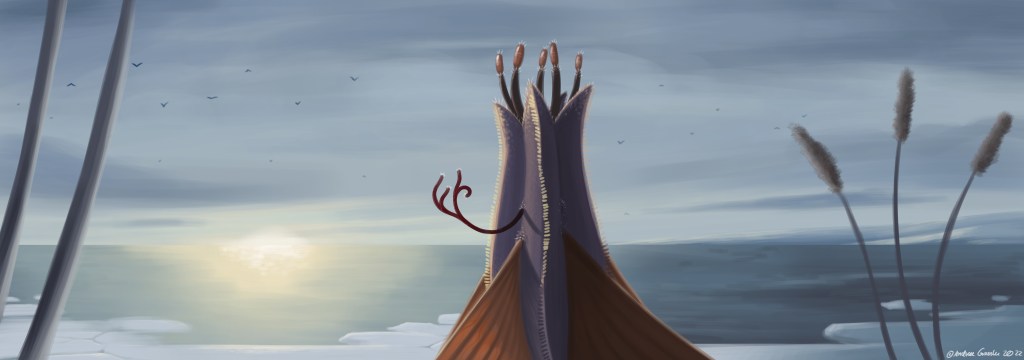
Featured Image: “Elder Thing” by juniorWoodchuck, licensed under CC BY-NC-ND 3.0 DEED.
 Sara Gabler
2 responses to “Where does the heart go? A reflection on sci-fi and quit lit”
[…] to understand reading communities and reading practices. Here’s one example, and another. (Hey, I said the digital humanities were ascendent, didn’t […]
LikeLike
[…] not a teacher anymore (for complex reasons I’ve explored, in part, elsewhere). So I’ve watched from the sidelines as those who would have been my students display great […]
LikeLike