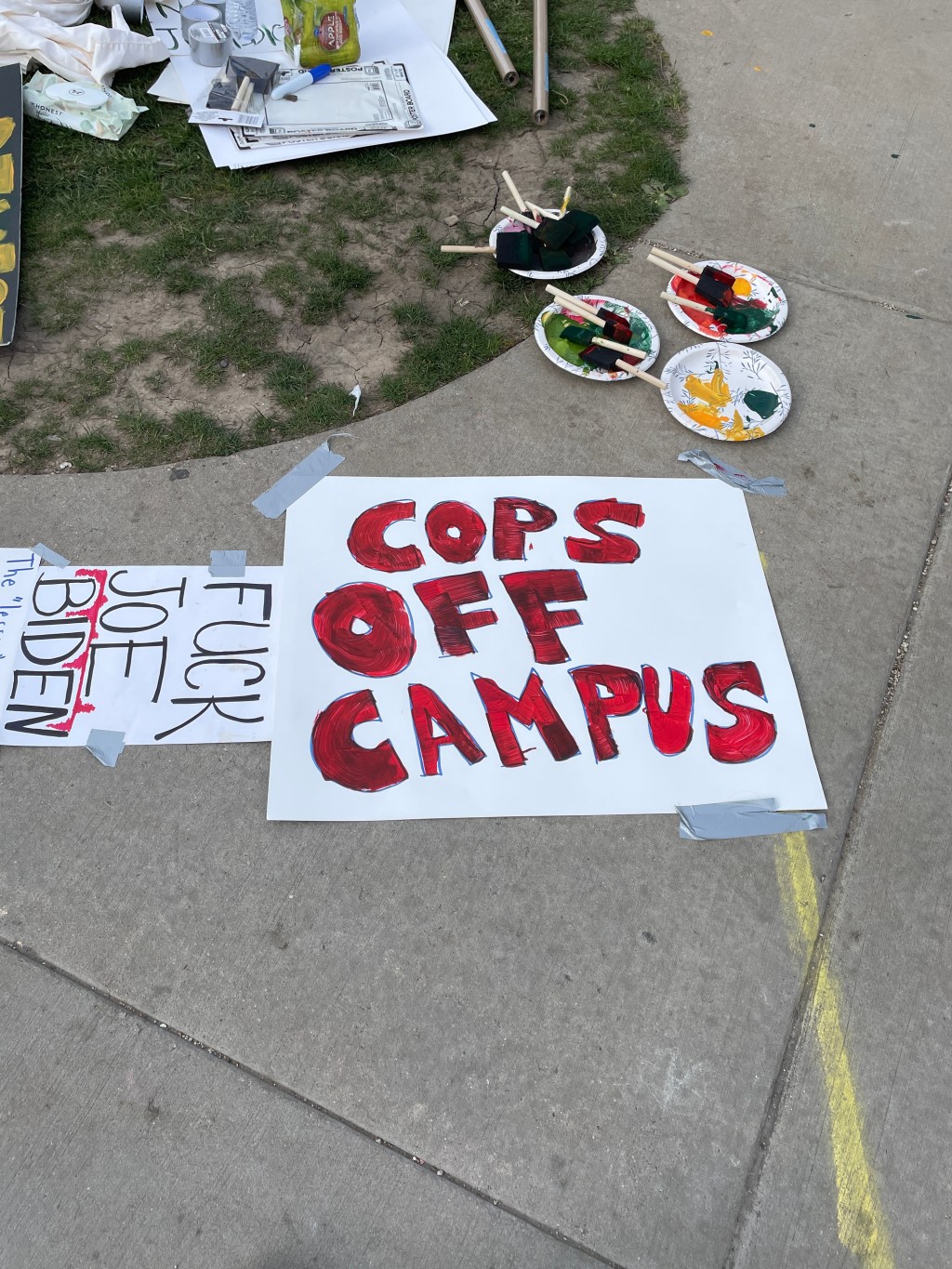
My reflection on student protests of the war on Gaza.
No one needs me to throw my hat in the ring with commentary on this moral and geopolitical situation. But writing helps me to process my experiences and emotions. I started writing this post in May.
I’m an American raised in a Christian Zionist community, and I taught at multiple US universities where students set up “liberated zones” and demand divestment. The F35 fighter jets that drop bombs on homes and hospitals in Gaza are running flight tests in the city where I live (Madison, WI). The local is global, as they say.
I’ve also visited the occupied territories, had lunch in Hebron, talked to Palestinians in Bethlehem and East Jerusalem, moved through Israeli checkpoints with the ease of my US passport, observed miles and miles of barbed wire.
Christian Zionism comes home to roost
I was raised as a Christian Zionist in an evangelical community in Texas. Central to this ideology is the belief that Jews will usher in the second-coming of Christ, a belief rooted in twentieth-century US based interpretations of biblical end-times prophecy. Evangelicals use this belief to shore up political and monetary support for the state of Israel, buttress support for the Israeli state’s occupation of Palestine, and vet conservative politicians in the US.
This is a wealthy and powerful movement–just take for example the collusion of AIPAC or the Christians United for Israel (CUFI) with US politicians.
Within this ideology, there is no room for the lives or voices of Jewish people. Christian Zionists will say that their support of Israel will bring them god’s “blessing,” yet they believe that Jews will go to heaven only if they give up their faith and follow Jesus. There’s a lot of anti-semitism within the Christian Zionist movement, and a hell of a lot of anti-Arab and anti-Muslim sentiment.
I went to college and unlearned that harmful ideology. College changed my life and brought me out of the insular and ignorant worldview I was raised in. Instead of fear and hatred of the “other,” I learned the tools of analysis, critical thinking, and empathy that were missing from my early education by extremists.
So when my college professors announced a study away trip to Israel and Palestine, I signed up. And what I saw were borders and beauty and history and animosity.
Now, as I’ve watched colleges crack down on anti-Zionist, pro-Palestinian protestors, I’m seeing the ideology of my upbringing come home to roost on college campuses where, at their best, social change can be nurtured.
Turning against students
I’m not a teacher anymore (for complex reasons I’ve explored, in part, elsewhere). So I’ve watched from the sidelines as those who would have been my students display great eloquence, moral acumen, as well as sincere care and attention to each other in their protest over the war on Gaza and US colleges and universities’ complicity in arming the state of Israel. I respect these students, especially those brave students at the University of Mississippi, whose courage surpasses my own.
But because of their age and eagerness, students’ concerns are often disregarded. Sara Ahmed calls this the “politics of dismissal” in which
“various points of view can be dismissed by being swept away or swept up by the charge of willfulness. So: What protesters are protesting about can be ignored when protesters are assumed to be from too much will; they are assumed to be opposing something because they are being oppositional.”
When I was teaching in higher-ed, I would re-read Ahmed’s essay, “Against Students” every year. I didn’t want to be like the old-guard academics and hypercritical public who view oppositional students as “over-sensitive” and “complaining.” I wanted to be for my students.
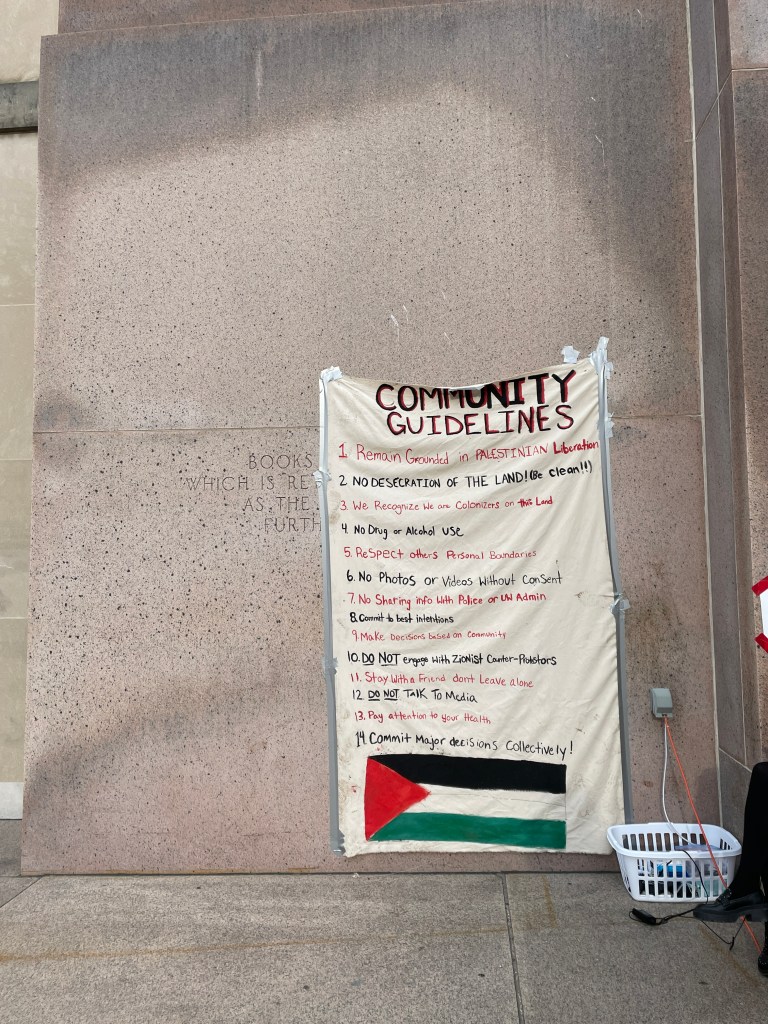
There are plenty of uncritical and uninformed dismissals of student protesters coming from school administrators (most without education experience like Jay Rothman, president of the UW System) and talking heads (like Jake Tapper–who breaks all 5 points of ethical protest coverage in this interview). Both brush aside what students are protesting for.
Ahmed would say that Rothman, Tapper, and others of their ilk are “against students.” They go as far as to consider certain willful students “a threat to education, to free speech, to civilization, even to life itself,” as Ahmed says.
Though these students are enacting their education and using their constitutional right to free speech, Rothman and Tapper perform a bait and switch in which they, as the “adult” institutional gatekeepers, become the true avatars of “freedom, reason, education, democracy.”
Rothman’s statements in response to the student protesters are a case in point. Rather than addressing student concerns he appeals to law and order saying: “We commit to upholding free speech rights while simultaneously upholding the law.” Free speech does not mean these students’ free speech, but the free speech of other more conservative-minded students whose free speech the UW System went to great lengths to prove is infringed upon. And the “law” takes precedence over the protesting students and their free speech rights.
The “law” in question is a statute barring camping on campus. It was put in place in the 70s following the protest movements of the 60s; but it has mostly been used to keep students from camping out before football games or to keep unhoused students from sleeping in university buildings, as I found through an open records request from the University. Rothman and others seem incapable of acknowledging what UW–Madison Law School professor Heinz Klug describes as the symbolic speech of the tents.
Student protesters are keenly aware that their tuition is bankrolling arms dealers. And this is the issue that administrators ignore by shifting the ground to the petty application of a legal technicality.
Rothman goes on to praise UW–Madison chancellor Jennifer Mnookin’s decision to send the campus police against peaceful protesters, saying: “I commend Chancellor Jennifer Mnookin for her reasonableness and resolve, as well as her commitment to free expression and the safety and security of her students.”
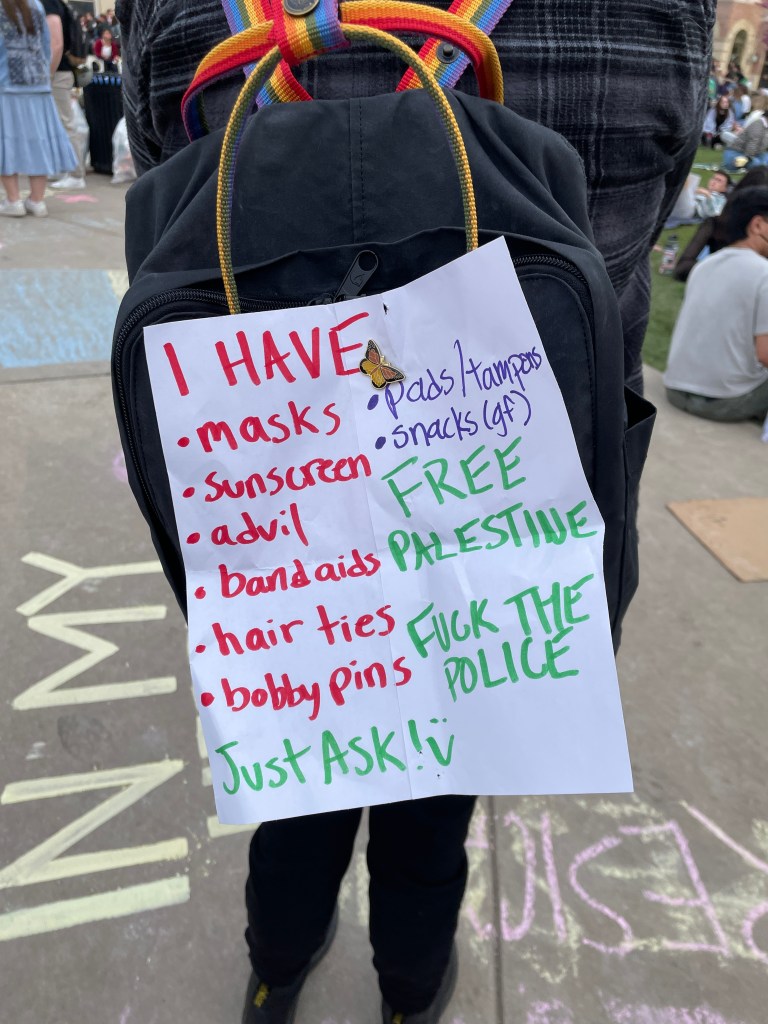
Here’s the bait and switch: the bureaucratic leader is praised for her “reasonableness” when in fact this person has betrayed students by sending a militarized police force to punish them for performing an unsavory protest that offends (because it challenges) Ivory Tower elites and their conservative financiers. Her “reasonableness” prioritizes a patch of grass and donor relations over students.
The root of so many college’s violent crack-downs on student protest–and what gets coded as the universities pursuit of freedom, reason, education, and democracy–is the overwhelmingly conservatism of university administration, boards and regents, and old-guard academics love of their own comfort, position, and status quo. But this is all hand-in-hand with the reality of higher education these days: that the business mission of the school precedes its educational mission.
To watch as colleges and universities across the country are actively supporting Zionist ideology is painful and scary for me. I worked in higher-education for 10 years because I believed that education was a pathway to enlightenment, critical awareness, or something idealistic that I don’t hold as dearly as I once did.
In part, my disillusionment with academia is similar to that of the student protesters: they’re seeing those in power do nothing to address the social and geopolitical issues that they’re taught to analyze and ameliorate. They’re seeing that the capital “U” university functions like a bank, and they’re refusing to be docile little banks themselves.
Photo credits: me. Find my reporting on the SJP liberated zone at WORTfm.
 Sara Gabler