
250 years ago, a mage named Windsor unlocked a conduit that made it possible to synchronize the wind and sea currents.
On a lonely and rocky island called Marrow, Windsor set about harmonizing the elements. His goal: to return all the wayward isles of the world to one unified land mass. That landmass would have at its center the Isle of Marrow where Windsor’s tower rose at the edge of the sea, the cliffs and shattered obelisk below it clouded and disintegrating.
He called his discovery The Great Aeolius. And it destroyed the Drift.
The Drift was the pattern of island movement across the watery world of Aarde. The people of Aarde long ago mapped the Drift, at first using elaborate mobiles of string and rocks to chart the paths of the lands. More recently, the Royal Cartographic Society put itself in charge of coordinating exchange and travel across the Drift, often in opposition to the healthy number of pirating operations who were keen cartographers in their own fashion.
“To know the winds and waves, is to know the way,” many a pirate would recite. But The Great Aeolius changed the winds and waves, and so it changed all the ways that people had to understand the world of Aarde.
Few people know of Windsor, the mage who unlocked the elements, because it wasn’t Windsor who set about unifying the world. That was the work of the network of politicos, pirates, and priests known as Pangea. They spread their message of synchronicity, and it was popular for a time. It would be beneficial for the people of Aarde to find “common ground,” to usher in an age of collaboration and accord and dispense with pirating, so they said. But their message soured from one of synchronicity into one of conformity. The exchange, the polyvocality, and the polyrhythms that defined the world became an impediment, and unity came to mean the unification of the lands and the unification of all thought. The ideals of Pangea were always corrupt, and it was too late when the peoples of the world began to understand what had been done to them.
Now, the Isle of Marrow sits at the center of the world, yawning. As other isles are pulled out of the Drift, crops fail, sea trade is no longer predictable, whole trading ports find they’re at the wrong end of the winds, isles collide and sink. There is great famine and suffering.
Nearly a hundred years after The Great Aeolius, a group of young upstarts attempted a coup. Infiltrating one of Pangea’s outposts on the Isle of Fame, they hoped to sabotage Pangea’s operations in the Sandeen Archipelago. As it happened to be the closest to the Isle of Marrow at the time of the Aeolius, the Sandeen Archipelago was one of the worst affected regions of the world. Some of its isles were pulled into each other. Some were lost. The Sunken Uprising (as the rebellion was later called) was nearly to completion when it was thwarted by the Pangea operative, Odysseus who went on to hunt down the saboteurs mercilessly.
In the years since, groups like the People’s Union, the Highlanders, the Royal Cartographic Society, and others have been more or less aligned with Pangea, finding alliances of empathy and opportunity. Though it has not been substantiated, some believe Odysseus was the mastermind behind the Night of Fire and Tears, when many temples of the Church of the Earthly Heavens were burned by the People’s Union.
Other groups maintain their independence, and the fiercest of those are the Shipbuilders.
The Lamian Navy, whose motto is “From Isle to Isle,” the Church of the Earthly Heavens, and the Fatal Tides gambling syndicate consider themselves neutral or disinterested, preferring to make and follow their own precepts.
Then, 50 years ago, five brave and unconventional warriors traveled to the Isle of Marrow to put a stop to Windsor: Coraleus, a monk in the Church of the Earthly Heavens; Lazlo and Hawk Corrigan, the former a pirate and the latter the last caretaker of the Sacred Spring; Caspian Tamlas, the son of a long line of shipbuilders; and Stump, who carried a magical map from the Royal Cartographic Society. Their names are spoken in hushed voices and only in certain circles.
They gave their lives to defeat the mage, hoping to interrupt his magic. They succeeded in that sense. Windsor was defeated, but that defeat did not restore the Drift. Pangea was too smart to have put all their power into the Isle of Marrow alone. Nevertheless, the destruction of Windsor left in the remaining opposition factions the meager hope that they too could oppose Pangea. Whispers spread of the Last Battle. A leader down. A chance to restore the Drift.
You, adventurers, were born into a world without the Drift, but you can’t shake it. Like an aftertaste, you sense the disharmony in the air, even in the Malay Archipelago, far away from the epicenter of the Aeolius where the destruction was swiftest.
Whether you know of him or not, Windsor is gone and Pangea remains.
50 years after the Last Battle, this is where your adventure starts.
—-
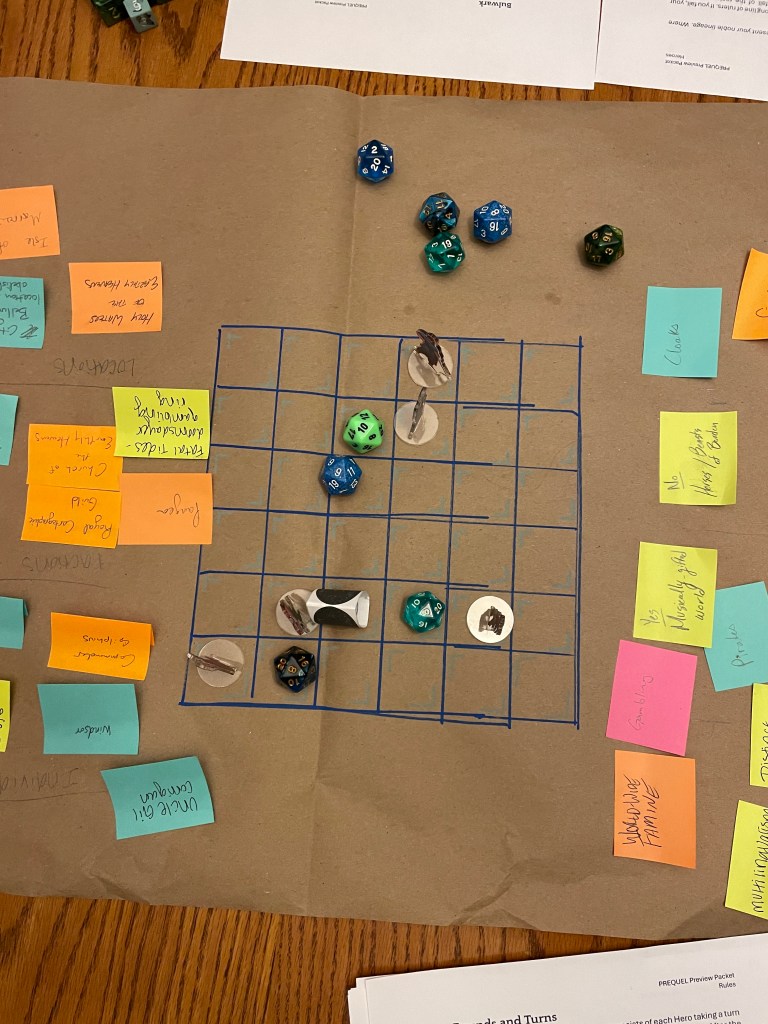
My regular gaming group played the preview of James Quigley and Ethan Yen’s Prequel this summer. And then we played it a second time, adjusting some of the rules (we gave the Evil fewer turns) and building a world for our next 5e campaign. A few sessions into that new campaign and we all feel more ownership and connection to the world, and players correct me (the GM) when I forget elements of our setting.
I read the narrative above to my group on our first session.

 Sara Gabler